 Ask anything
Purchase Order Request
All20 Submitted by me0 Open9Support Tickets
All22 Assigned to me0 Open14A faithful model of the Claromentis business process dashboard, built from the real screen. Ticket summaries and staff names are sample data; the screen, its widgets and its labels are the product. Not a live system. The real one is in the free 30-day demo.
What should you automate first?
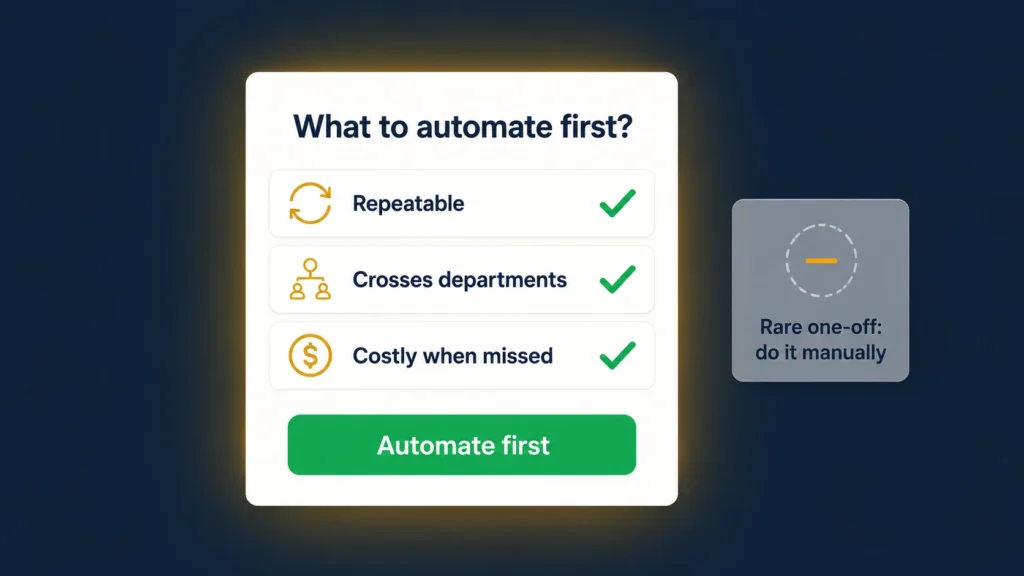
Start with the process that is repeatable, crosses departments, and hurts when it slips. Repeatable means it happens often enough that the setup pays back. Cross-department means it currently dies in email handoffs. Hurts means a real cost when a step is missed: a late approval, a compliance gap, a customer kept waiting.
For most UK SMEs the first candidates are approvals (leave, expenses, purchase orders), customer or supplier requests, and the joiner and leaver lifecycle. That last one, the starters, movers and leavers process, is the worked example we cover in depth, because the leaver half is where access quietly gets left switched on.
One rule decides whether it works: fix the process before you automate it. Practitioners say the same thing repeatedly, because automating a broken process just makes the mess happen faster. Map the steps on paper first. If you cannot draw it, you cannot automate it.
Do you need to be technical to automate a process?
No, and that surprises people. Modern business process automation runs on no-code platforms: you build a workflow by dragging form fields and approval steps into place, without writing a line of code, using a tool like Claromentis InfoCapture. The person who owns the process can build it, change it and fix it.
This is the part that matters most for the SMEs this guide is written for. If you have no in-house IT, a tool that needs a developer for every rule change is one you will quietly abandon. A no-code builder removes that dependency. The HR lead adjusts the onboarding form. The office manager adds an approval step. Nobody waits for a ticket.
Claromentis 11 helps the person running it, too. Its in-portal AI Chat Assistant can connect to the Claromentis knowledge base, Discover, so administrators get product-level “how do I set this up” answers, approved by Claromentis, inside the tool (Claromentis, 2026). Our Claromentis 11 deep-dive covers it. That shortens the learning curve for whoever ends up owning automation.
What automation costs, and whether it pays off
Be wary of any guide that quotes you a precise figure. The honest answer is that the cost of business process automation depends on the process, and the durable evidence is about value, not price. Adopting the right technology delivers firm-level productivity gains of 7 to 18% per technology adopted (GOV.UK, 2025). At national scale, lifting UK SME productivity by just 1% a year over five years would add around £94 billion a year to GDP (Be the Business, via GOV.UK, 2025).
The real question is build versus buy. Building bespoke automation gives you exactly what you want and a maintenance bill forever. Buying a no-code platform gives you a tool your own team can change, without a developer on call. For a firm of 10 to 500 staff with no in-house engineering, buying almost always wins, because the cost that kills automation is not the licence, it is the upkeep.
If you want a sense of platform-level budgets, an integrated digital workplace runs roughly £8,000 to £25,000 in year one for 30 to 100 users, across intranet, automation and learning together.
Why do business process automation projects stall?
Rarely because the technology fails. They stall because the process was never clear and nobody owned the result. KPMG’s analysis of why automation initiatives fail puts the top reason as treating automation as an experiment or side interest, without a clear strategy or anyone tracking the benefit (KPMG, 2024).
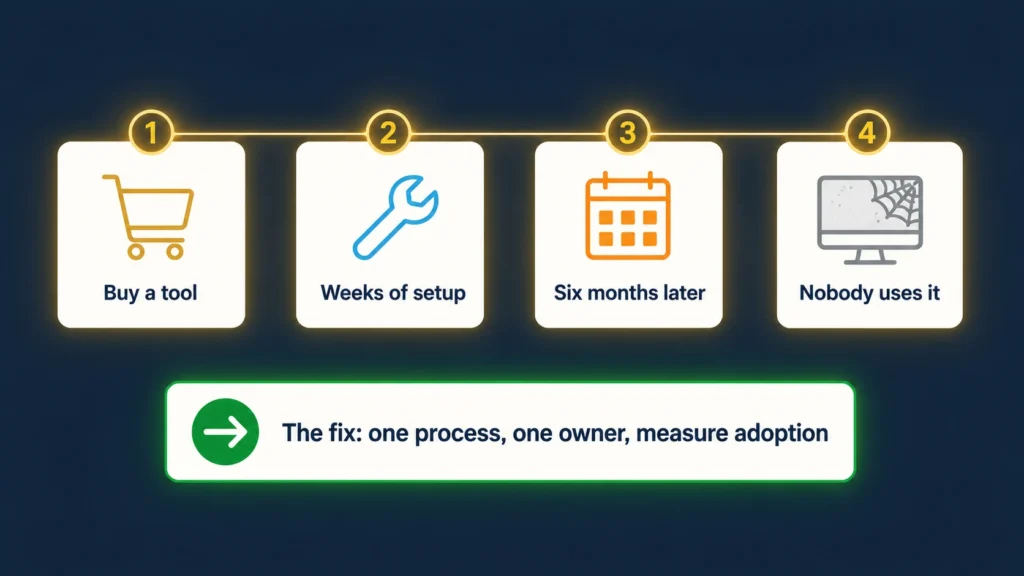
Practitioners describe the same arc. A founder gets excited, buys a tool, spends weeks setting it up, and six months later nobody uses it. As one automation specialist put it, if your team needs a manual to use the automation, it has already failed (EasyScalers, 2025).
The fix is unglamorous. Pick one process, define it properly, give it an owner, and measure whether people still use it after a quarter. A small automation people actually run beats a clever one they quietly abandon.
Why does scattered automation become a liability when someone leaves?
Because an automation tied to one person’s account is a single point of failure. When that person leaves, the workflow can break. Microsoft’s own documentation is blunt about it: a flow becomes orphaned when its owner leaves the organisation, and it “can fail if they use connections tied to that user account” (Microsoft, 2026). On Hacker News, practitioners discussing why long projects fail point to the same thing: constant knowledge leaks as people leave.
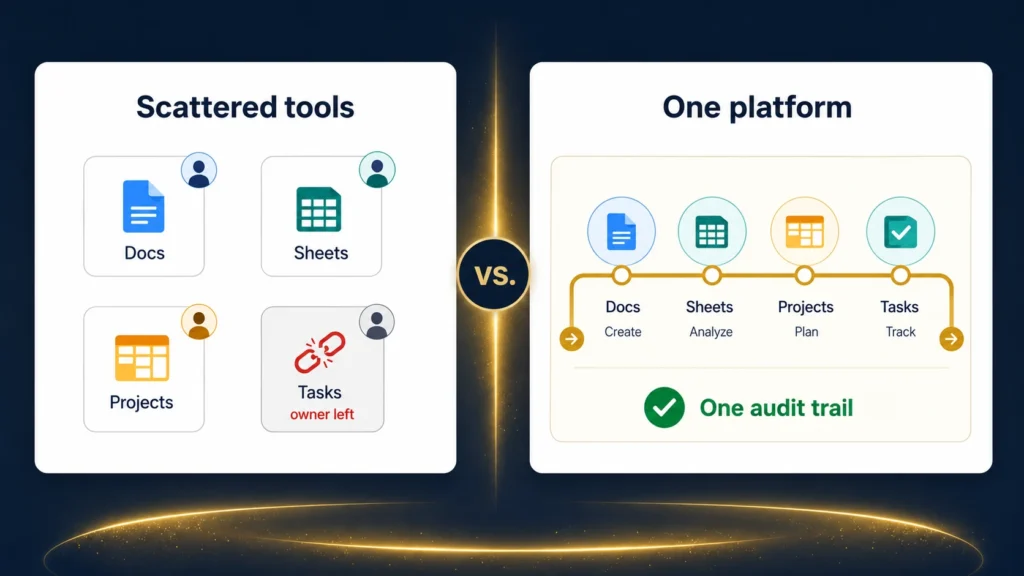
Now multiply that by a drawer full of point tools, each set up by a different person, none of them logged in one place. That is the hidden cost of automation by sprawl: it works until someone leaves, then nobody knows what broke or why.
The alternative is to run automation inside the platform your team already uses, so the workflow lives beside the documents, the directory and the audit trail. One login, one owner of record, one place to look. That is the case for building business process automation into your core intranet rather than bolting on disconnected apps.
How should a UK SME start with business process automation?
Treat it as an afternoon’s decision, not a transformation programme. The sequence that works for a UK SME is short and deliberately boring.
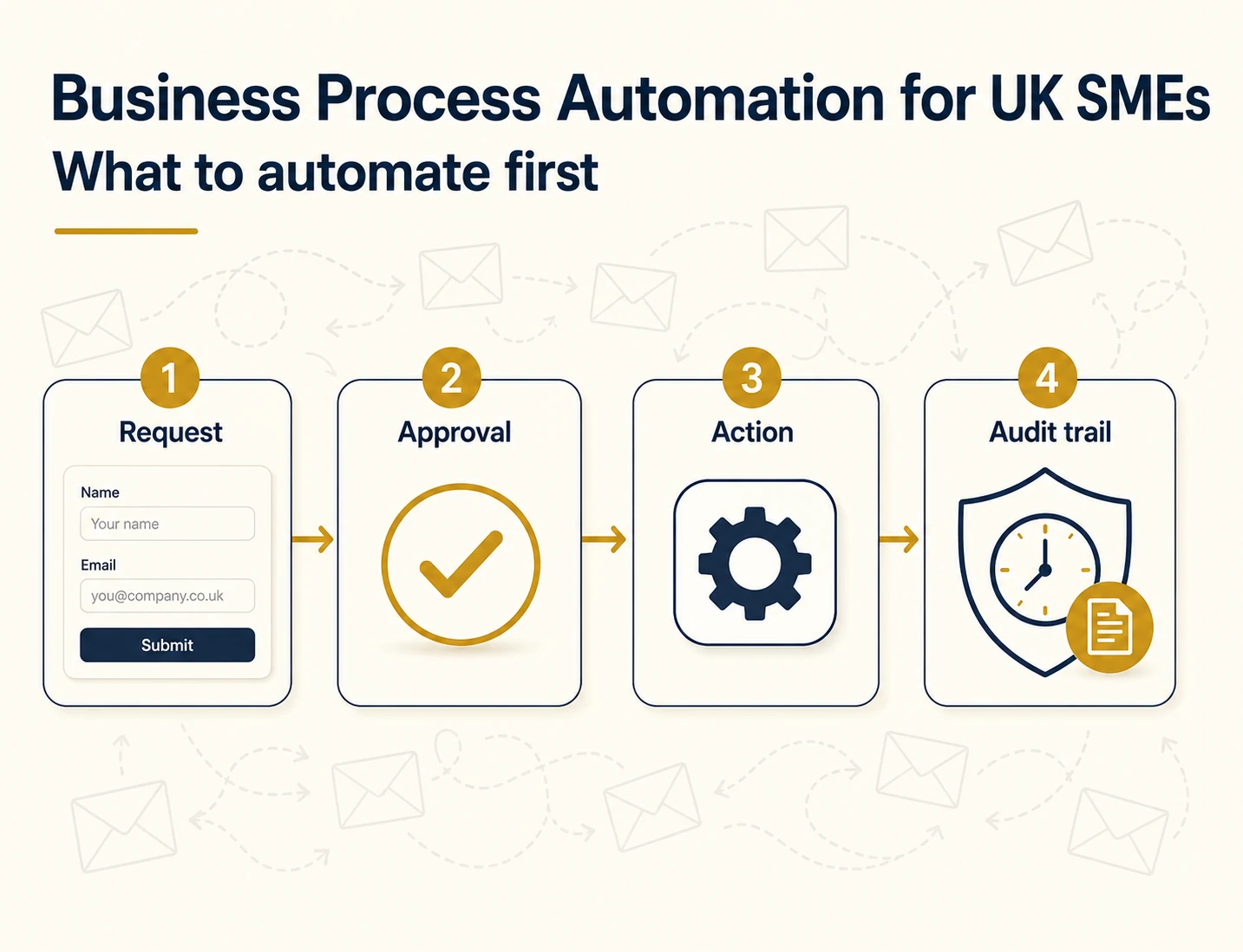
First, list the three processes that hurt most and pick the one that is repeatable and crosses departments. Second, map it on one page: who does what, in what order, and where it currently breaks. Third, build that single process in a no-code tool such as Claromentis InfoCapture, with a digital form, approval routing and an audit trail. Because it is drag-and-drop, your own team can change it later, with no developer needed.
Fourth, give it an owner and a review date. Check after three months whether people still use it. If they do, automate the next process. If they do not, find out why before you build anything else. Adoption is the only metric that matters; everything else is vanity.
The bottom line for UK SMEs
Business process automation for UK SMEs is not a software shopping trip. It is a decision: pick the one repeatable, cross-department process that hurts most, map it, and automate that before you touch anything else. Automate the routine, hire for judgement, give every workflow an owner, and check that people still use it after three months.
Done that way, automation is one afternoon’s work that keeps paying back. Done the other way, it is a tool nobody opens by spring.
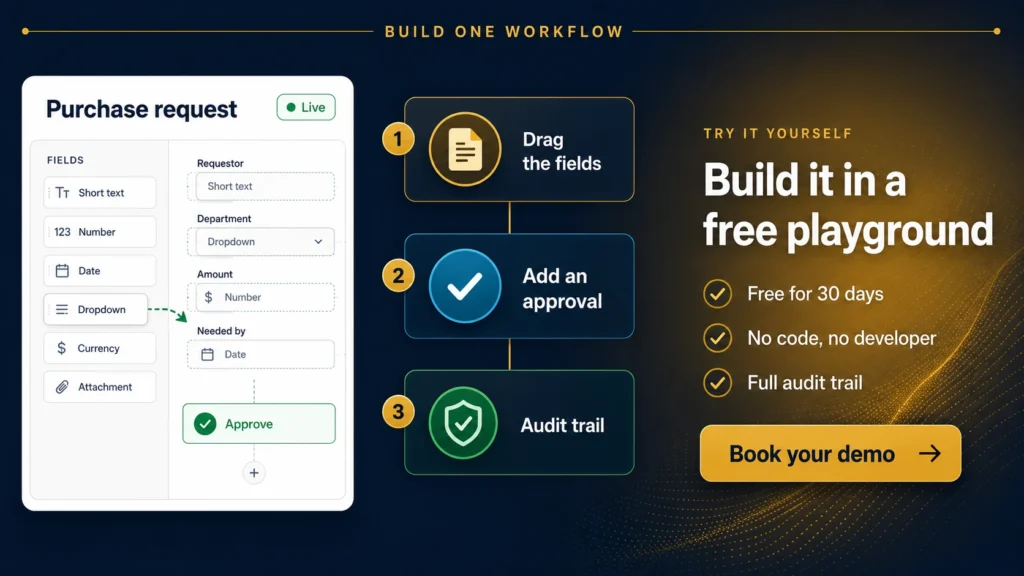
Want to test the decision before you commit? We’ll set you up with a free 30-day Claromentis demo playground, so you can build one real workflow, route a real approval, and see the audit trail for yourself.